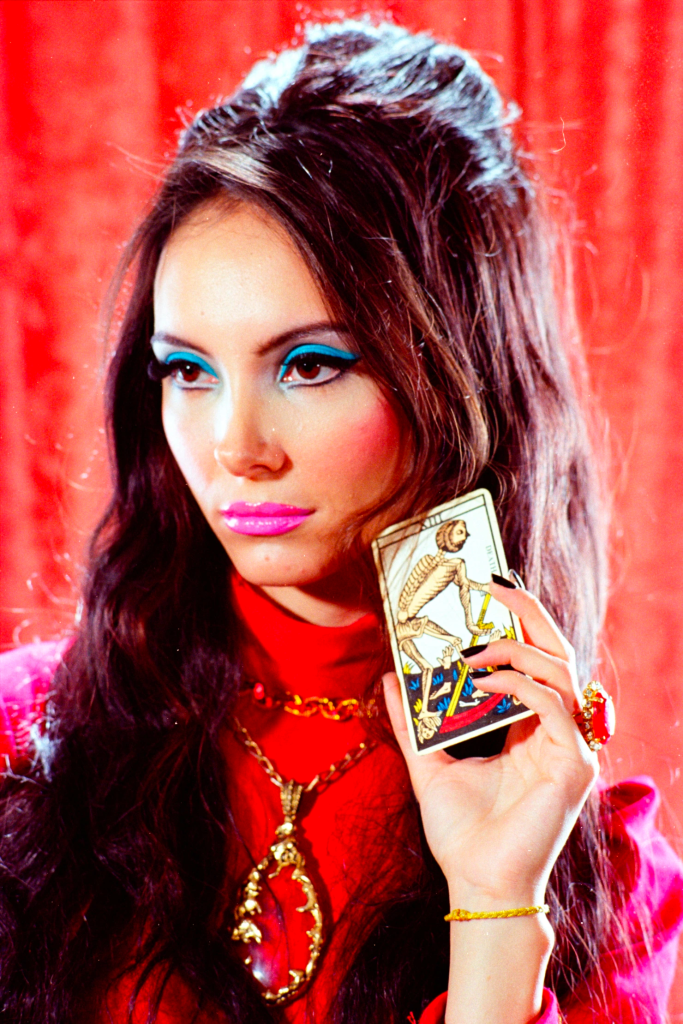
The Love Witch is a film by Anna Biller. It centers around Elaine, who like many of us has grown up being fed the fantasy of the strong and capable Prince who would smite all the Princess’s demons and love her fiercely. A fantasy produced by a patriarchal system which, through the use of the male gaze, limits women to damsels in distress in need of a hyper-masculine male savior, rewarded with the damsel’s body and beauty. Female fantasies are influenced by the male gaze in The Love Witch, twisted and mutated by the normalized stereotypical gender roles and desires of cis-gendered heterosexual men. Elaine is more than willing to drug a man. She will do anything to bring her one step closer to finding the man of her dreams.
Simone de Beauvoir wrote in The Second Sex (1954), about the archetype of “the woman in love” who “having no basis to form her own identity separate from her relationships … seeks subjectivity through the eyes of another, in this case, her romantic partner”. Through this lens Elaine commits morally objectionable and illegal acts on her non-consenting lovers to generate a reaction from them that she perceives to be the opening of their hearts to her. Elaine’s use of her body and sex magic as a sort of toxin to ensnare and bewitch men coupled with her belief that it will result in true and everlasting love can be recognized as another case of the successful patriarchal brainwashing of a receptive woman.
Once her fantasy is achieved, and she is being worshipped as a goddess by these men it’s not the same as self-worship. It doesn’t contain any human respect. There’s no real love there. Objectification precludes love. Elaine’s sexual encounters end with her harboring feelings of annoyance and repulsion as the men crumble into sobbing little boys begging her mother them. Biller presents the question of “‘… what would happen if men loved women as strongly as women want them to; the way women crave to be loved by men. Men are known for being much less emotional than women, but, in my experience, they’re much more emotional. And that’s why they won’t, or can’t, open that gate – it would destroy them. And that’s what kills all the men in my movie – having to experience their own feelings’”
Biller thinks that’s all men will take from the film — the visuals — but that women will go further. The Love Witch is about the female experience, portraying a woman’s inner life. For the character of Elaine, Biller drew from the figure of the witch and the femme fatale archetype, which are traditionally feared by men because of how they embody female sexuality. “It’s about male projection onto women that they’re a witch, either an evil witch or a sexy witch,” “And then the difference between that is a woman’s interior experience of herself and her own power,” though “not necessarily in the service of any man, [but] in an actual witchy powerful way.”
Biller creates visual pleasure for women “through interior decorating.” Instead of featuring weapons, guns, cars, objects of war and destruction, she’s “obsessively featuring lace doilies, tea sets, handbags, false eyelashes, ashtrays, curtains, pillows, domestic things.” Biller isn’t trying to say that women are domestic, though, it’s just “a way of creating a world of objects that feel female.” She also isn’t saying that all women enjoy feminine things or that women are defined by these things, but she wants to include the stuff that excites her on screen. “Maybe it excites me to put a beautiful woman on screen and have her wear beautiful makeup and have her look fantastic, you know, great stockings, great lingerie, great shoes, great handbag.” This might seem like a male fantasy at first, but is it? Do men care about these things in the same way that women do?
Also “there’s so much judgement of women who conform to beauty standards; they’re mocked relentlessly for being shallow or stuck or a bitch. But there’s even more ridicule for women who refuse to conform to beauty standards or to please men.” They think they’re safe, but neither is because they’re “stuck in a world where only male desire matters.” Biller explains that Elaine can get any man she wants by looking how she does and pleasing them, “but none of them are worth it because they objectify or dominate her, leaving no space for her to grow or self-actualise or love.” Trish is more secure in herself and isn’t performing in those ways, but her husband still goes for a “blank sexuality image of woman which is all Elaine gives them, rather than a real woman.”
Biller said she looked into Borderline Personality Disorder: “For Borderline people, the love object is fetishised, but when it disappoints too much, it becomes devalued and discarded. Once it’s discarded it becomes a thing of evil, and it’s the thing you have to kill. ….. So then she kills him because she just has to get rid of the thing that he is that has a personality, so she can fantasise about him as the thing she wants him to be.” The concept of idealisation and devaluation, commonly seen in the BPD profile, is an idea that works exceptionally well here (not to say that everyone with BPD is likely to kill their lover).
 Chelsea Swan
Leave a comment